

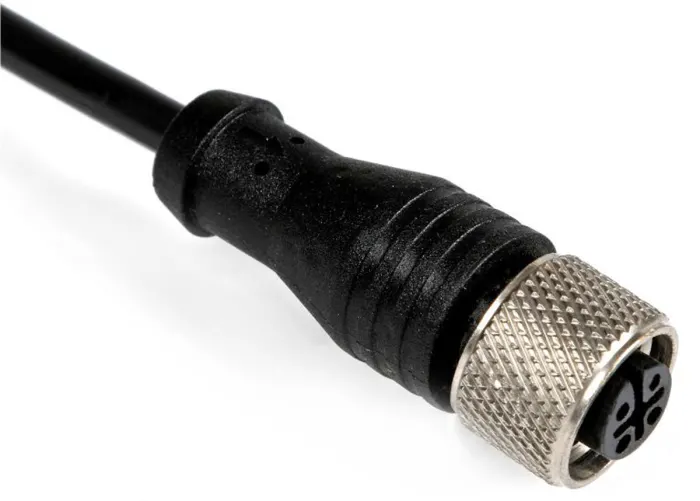
In industrial automation and electronic systems, choosing the right connector is critical for performance, reliability, and long-term maintenance. Among the most commonly used circular connectors are M8 and M12 connectors. Both are widely adopted across industries such as manufacturing, robotics, transportation, and process control. While they may appear similar at first glance, they serve different purposes and are optimized for different technical requirements. Understanding the key differences between these two connector types helps engineers and system designers make informed decisions.
M8 and M12 connectors are named after the diameter of their metric locking threads: 8 millimeters and 12 millimeters respectively. This size difference has a direct impact on their electrical capacity, mechanical strength, and suitable applications. The following sections explain how these connectors differ in terms of size, performance, use cases, and overall advantages.
Overview of M8 and M12 Connectors
M8 connectors are compact circular connectors primarily designed for low-power and signal transmission applications. Their small footprint makes them ideal for environments where space is limited, such as compact machinery, miniature sensors, and tightly packed control panels. The M8 Connector is frequently used in sensor and actuator connections and is valued for its lightweight design and ease of installation. Detailed technical options and configurations of the M8 Connector show how it supports reliable connectivity while maintaining a minimal physical profile.
M12 connectors, on the other hand, are larger and more robust. They are designed to handle higher power, higher data rates, and more demanding industrial environments. Due to their increased pin capacity and stronger housing, M12 connectors are often chosen for applications that require durability, long cable runs, or higher electrical loads.
Size and Physical Design Differences
One of the most noticeable differences between M8 and M12 connectors is their size. M8 connectors have an 8 mm threaded coupling, making them significantly smaller than M12 connectors, which use a 12 mm thread. This size difference affects not only the connector itself but also cable thickness, bend radius, and installation flexibility.
M8 connectors are best suited for compact devices and applications where weight and space savings are essential. M12 connectors, while larger, offer better mechanical stability and strain relief. This makes them more suitable for heavy-duty industrial environments with constant vibration or movement.
Electrical Performance and Pin Configurations
Electrical capability is another major point of distinction. M8 connectors typically support fewer pins, commonly ranging from 2 to 8 pins, and are intended for low-voltage and low-current applications. They are commonly used for simple signal transmission, sensor feedback, and basic control functions.
M12 connectors offer a wider range of pin configurations, including options that support power, signal, and high-speed data such as Ethernet. This makes M12 connectors more versatile for complex automation systems where multiple signals or higher power levels are required. Their design allows for better insulation and spacing between pins, improving electrical safety and performance.
Environmental Protection and Durability
Both M8 and M12 connectors are designed for industrial use and often come with high ingress protection ratings, such as IP67 or IP68. However, M12 connectors generally provide superior durability due to their larger size and stronger housing materials. They are better equipped to withstand harsh conditions, including extreme temperatures, mechanical stress, and exposure to oils or chemicals.
M8 connectors also offer solid environmental protection but are typically used in less demanding conditions or where compactness takes priority over maximum ruggedness.
Typical Applications and Use Cases
M8 connectors are commonly used in factory automation for proximity sensors, photoelectric sensors, and small actuators. They are ideal for applications that require compact connections without sacrificing reliability. Medical devices, laboratory equipment, and light industrial machinery also benefit from their small size and efficiency.
M12 connectors are widely used in heavy industrial automation, robotics, conveyor systems, and industrial networking. They are often selected for applications involving motors, fieldbus systems, and Ethernet communication where higher power and data integrity are essential.
Cost and Installation Considerations
From a cost perspective, M8 connectors are generally more affordable due to their smaller size and simpler design. They also require less space and lighter cables, which can reduce overall system costs. Installation is usually straightforward, especially in compact assemblies.
M12 connectors may have a higher initial cost, but they often provide better long-term value in demanding environments due to their durability and versatility. Their robust design can reduce maintenance and replacement costs over time.
Conclusion
The choice between M8 and M12 connectors depends largely on application requirements. M8 connectors excel in compact, low-power, and signal-based applications where space efficiency is crucial. M12 connectors are better suited for higher power, data-intensive, and harsh industrial environments. By understanding the key differences in size, performance, durability, and application scope, engineers can select the connector type that best supports system reliability and operational efficiency.